
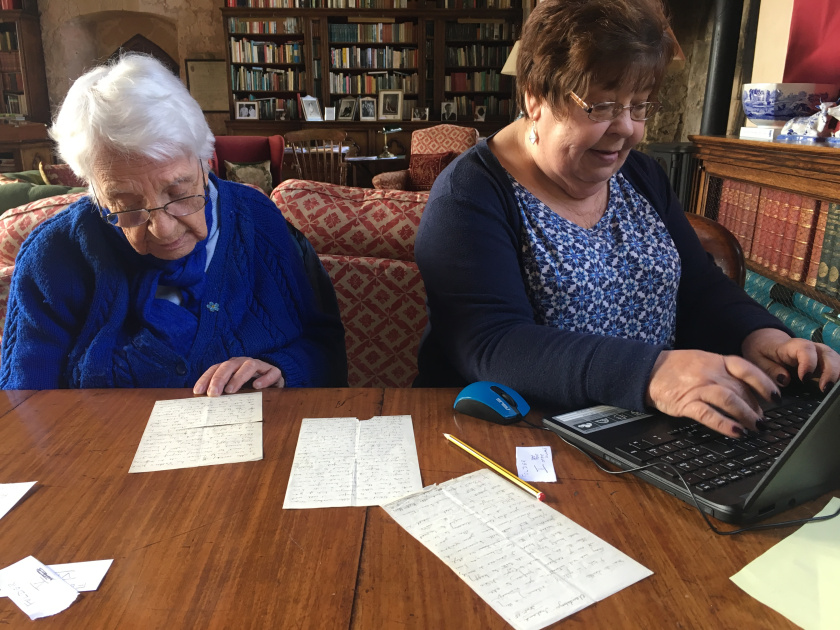
For quite a few years now I have been working as a volunteer at the moated medieval Markenfield Hall in North Yorkshire. With the co-operation of the present owners I wrote a history of the original family who gave the hall its name.

The book is the only history of the Markenfields in print and sells extremely well. As a consequence of this publication, I was asked to join the volunteer researchers at the hall. Now I visit once a week to catalogue and transcribe documents that are stored there. These documents date back to the early eighteenth century. Earlier documents are in archive collections around Yorkshire. Unfortunately, the documents that survive are mainly from the descendants of the Fletcher Norton, first Lord Grantley of Markenfield, and not the original family. The earlier documents disappeared sometime in the seventeenth century. The search for these documents is an ongoing task for the volunteers.
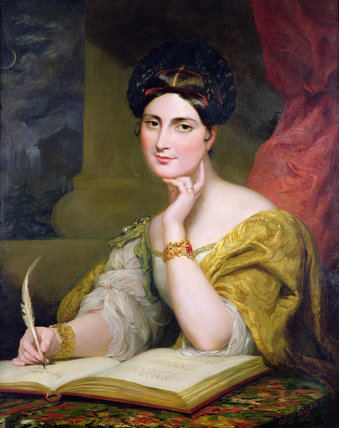
Some of the papers I have been transcribing are from the pen of this lady, Caroline Norton. Caroline was the victim of a bad marriage and, after leaving her husband, fought for the the laws on child custody to be changed. I am also a member of the Friends of the Bronte Society. Last year, a letter by Caroline Norton was purchased for the museum. In the letter Caroline comments on the book Jane Eyre by Charlotte Bronte.

Caroline says “I never for an instance thought Jane Eyre likely to be hers”. She is referring to the feminist, social campaigner and reformer Mrs Josephine Butler. Many Bronte scholars believe that the sisters were aware of Caroline Norton and that her experiences influenced their writings. This is especially true of Anne Bronte’s The Tenant of Wildfell Hall.
I hope to introduce you to more of my historical research activities over the next few months.
THE EARLY MEMBERS OF THE MARKENFIELD FAMILY.
The first mentions of the family called Markenfield are in official documents such as the Percy Fees and the Chartulary of Fountains Abbey all compiled in the 11th and 12th centuries. Making a family tree for those periods is not an easy task as I soon found out. Historians in the 19th century provided some information but never answered my main question. Were the Markenfields a local family or did they come to England with William the Conqueror?
After years of research I feel I maybe nearer answering my question. The Markenfield family tree is believed to start with a man called Wimarc. This man was mentioned as steward of Richmond Castle for Count Alan of Brittany. [Early Yorkshire Charters – Honour of Richmond]. What do we know about this man? Well I need to go into a little background history before revealing the little knowledge we have of Wimarc.

Richard I of Normandy was known to have sired a large number of illegitimate children. Amongst his legitimate children was a daughter Emma who firstly married Aethelred the Unready. She was the mother of Edward the Confessor. One of Richard’s illegitimate daughters, and therefore half-sister to Emma, is believed to have been a lady named Wimarc. This lady had a son called Robert Fitzwimarc. So Robert and Edward were first cousins. When Cnut became King of England, and married Emma, Edward went to Normandy. He was there for over 20 years. There he met his cousin Robert Fitzwimarc and they became friends.

Edward returned to England to become king in 1042 and Robert travelled with him. Over the following years the king favoured him with honours and lands especially in the county of Essex where he was appointed sheriff. Robert was one of the four inner councillors present at Edward’s death and he is represented on the Bayeaux Tapestry. He supported Harold’s claim to the throne and was horrified when his cousin’s son William decided to invade England. The Anglo-Saxon Chronicles record Robert meeting with William and trying to persuade him to return without any fighting taking place. Obviously he was not successful! After the conquest Robert gained more land and built Rayleigh Castle

.
I don’t think this is our Wimarc. I believe there were two and that they were related. This is where Duke Alan of Brittany comes onto the scene. He was at Hastings and took part in the Harrying of the North. As a result he was rewarded with lands in Yorkshire and in the south of England. In fact, Rayleigh in Essex was part of what became the Honour of Richmond. Duke Alan built his castle overlooking the River Swale. He named it Richmond after the area in Brittany near where he had lived – Richmont.

I believe that the Markenfield Wimarc was part of Duke Alan’s entourage. As a reward for his support he was made steward of Richmond Castle and given lands in Yorkshire. For over two centuries the family were known as le Bret. Was this because they were from Brittany and supporters of Duke Alan? In the thirteenth century they were known as le Bret de Markenfield. It wasn’t until the fourteenth century that the le Bret finally disappeared.